Posted on

Equine Nutrition: Selenium

This is the second post in my nutrition series. If you missed the first one on vitamin E, here it is.

As equestrians, we want the best for our horses and part of that is understanding nutrition. As a horse and barn owner, I’ve always had an interest in digging deeper into recommendations from equine experts.

This week, I read through these two articles and summarized their notes and recommendations below for you:

Keynotes on Selenium in Equines

  • Selenium, an essential nutrient that horses get from grazing, is an antioxidant. It is also used in Thyroid function, muscle function, and immune system. It can also help prevent certain forms of cancer.
  • The soil in North America is poor in selenium, so pastures are equally poor.
  • Horses who work hard, such as endurance mounts, may require additional selenium.
  • Selenium and vitamin E go hand-in-hand: deficiencies in Vitamin E or Selenium can be compensated for if the other is plentiful.
  • Supplemented selenium has a good absorption rate compared to others.
  • A total of 3 mg of selenium daily is enough for most horses
  • Selenium deficiency can be hard to identify if the horse receives enough vitamin E, early signs include work intolerance, poor hair coat, and early onset of problems related to ageing.

What to do

Evaluate current feed—Look at the selenium content in your hay and other feeds and grains, if they are at 3 mg, awesome!

If Selenium deficiency is suspected—contact your veterinarian to have a blood test done. With advice from your veterinarian, add a selenium supplement to your horse’s diet. Careful—Work with your veterinarian to calculate how much selenium is currently in the horse’s diet, forage and grains), then supplement. Too much selenium and selenium toxicity can happen fast and be deadly.

Conclusion

Selenium is an essential nutrient for horses in North America, so it should be supplemented and in cases of deficiency, consult your veterinarian.

Hungry for more? Here is the next post in the series Equine nutrition: Biotin.

Posted on

Equine Nutrition: Vitamin E

As equestrians, we all want the best for our equine partners and part of that is the nutrition equation. As a horse and barn owner, I’ve always wanted to dig deeper into the nutritional recommendations from industry experts. 

I dug into three articles written by experts and pulled out their key points and takeaways: The first article “When Do Horses Need Vitamin E?” by Clair Thunes, PhD, the second by one of my favourite sources KER “Understanding Vitamin E in Equine Diets,” and the third article titled “Why your horse needs vitamin E” by renowned rancher Heather Smith Thomas

I strongly encourage you to read these articles when you have time as they are dense in information and great resources. The quick and short version is below. 

Key Notes on Vitamin E in equines 

  • Vitamin E, a fat-soluble vitamin, functions as an antioxidant and helps maintain muscles, nerves, and immune cells. 
  • Horses can’t produce Vitamin E, so they typically get it through grazing.  
  • Experts recommend about 500 IU daily as a maintenance level for a 1,100-pound horse in light work. 
  • Signs of Vitamin E deficiency include “muscle soreness and stiffness and slower-than-expected recovery” (TheHorse.com). 
Photo by Free Nature Stock from Pexels

Key takeaways 

  • Supplement based on diet – Horses on an exclusive hay diet require additional Vitamin E 
  • Supplement based on conditions – Aging or underweight horses as well as horses with health conditions require additional Vitamin E. 
  • Keep an eye out for signs – When in doubt, a blood test can determine if there is a deficiency. 

To conclude, Vitamin E is an essential nutrient that may need to be supplemented based on your horse’s diet, age, underlying conditions, and work.  

Hungry for more? Here is the second post of the series: Equine Nutrition: Selenium.

Posted on

Equestrian: 3 Bit Tips

Any horse rider knows, it can be a nightmare to choose just the right bit for your horse. As a rider and owner, I’ve more than once found myself in front of the bit rack at the tack shop, both mesmerized and paralyzed by the choice.

I found two articles to help demystify the bit question. The first article How Horse Bits Work and Basic Rider Uses published by Horses and Horse Information discussed the different actions the bit has in the horse’s mouth and debunks the myth that to control “a big animal, one needs a strong bit.” The principle is that correctly fitting bit and bridle will create pressure from which the horse will move away.

In the second article Understanding Bits by Stan Walchuk Jr., the author suggests putting bits in two categories: snaffle and curb. The snaffle bit has no shanks or levers. The article also discusses the raised ports to relieve tongue pressure and apply pressure on the roof of the mouth and gives examples of the different types of bits. It further discusses the correlation between bit severity and training, by stating that severe bits should not be used with green horses or inexperienced riders.

Bit checklist

After reading these two articles and my experience, here are three things you should consider when looking for a new bit for your horse.

  1. Width—Measure your horse and buy the appropriately sized bit.
  2. Shape—Consider the shape of the bit and your horse’s mouth to reduce or add pressure.
  3. Leverage—Look at how much pressure the bit exerts in the horse’s mouth.

To conclude, you now know the bit basics before deciding to change or buy a bit. Happy shopping!

My name is Chloe. I’m a passionate equestrian, horse lover and hobby farm owner with three horses in my care. I’ve been riding (on and off) since the tender age of 6 and love to discuss anything horse-related. Feel free to connect with me at @eqnextdoor on Twitter or Equestrian Next Door on Facebook.

Posted on

Summer Fling – My 2nd distance competition

Our second ever competition was at Summer Fling. We signed up for a 25-mile Set Speed Bronze. If you missed my blog post about my first competition, here it is.

The day started early after a bad night’s sleep. (Whoever sleeps well the night before a competition anyway?)

I had made my list and checked it twice (may have added some things to it twice too). I packed throughout the week leading up to the competition. The night before I checked my packing against my list and made sure Alice’s fuzzy’s were installed on her halter.

Trailering Out

The morning of the competition we managed to get Alice on the trailer and hit the road on time. It only took about an hour to get to camp. Alice travelled like a champ and was nervous walking around camp but settled right down to work when we started saddling.

Initial Vetting

We vetted through before starting. Alice was “plumply” hydrated, but she had a sore lumbar and her gut sounds were low. We were told to get her to eat and drink as much as we could, which wasn’t too hard considering I was trying to stop her from eating at the vet’s feet while we chatted. We came away with an overall impression of B to start.

Start

The ride started 30 minutes later than anticipated which worked for us. It meant getting home later, but we had more time to tack up and eat. Julie helped me tack up and installed the heart rate monitor. Soon enough Alice and I were off.

This was our first ride alone as Julie had an injured foot and couldn’t ride. We took off slowly even if Alice was willing to give me a nice trot at the onset. There was a long stretch of gravel road leading from and to camp which I decided to walk because Alice didn’t have any hoof protection.

First Loop

The first loop went by like a breeze. Alice found her groove and all she wanted was to move. She didn’t drink at all though and ate on the way back along the gravel road. She loves her hackamore for that. When we got back and vetted through, Alice was slightly dehydrated, which was no surprise. Thankfully her gut sounds and her sore lumbar were getting better.

Julie took care of Alice during the hold and I tried to plan the second longer loop. We gave her electrolytes and lots of wet hay to get some water in her. And then we were off again!

Second Loop

The second loop was much slower. The footing was decent though we couldn’t see most of the time due to the overgrown grass. There were some downed trees along the way, some we could walk over, others we had to detour into the forest.

The ride itself was good. I learned that Alice does better either alone or with a friend that she knows. She also has a big stride on her once she is warmed up, so other horses have trouble keeping up with her. She also likes to try to pass if the horse in front is slow.

Alice didn’t drink during the first loop and the second loop didn’t start out any better. She only started drinking halfway through the second loop and then she drank at every chance she got. Julie had made it clear that we weren’t allowed back at camp unless we had spent 3 hours on the second loop. I started to slow down as well towards the end of the last loop. Not so much cramping as muscle fatigue. At any rate, we slowly walked back to base camp in an effort to keep her heart rate down and to allow her to eat along the gravel road.

We took a little more than 3 hours for the second loop and came in with a happy horse and tired rider. Alice pulsed down nicely and we presented for 20 mins with a heart rate of 44. Great improvement over Merrickville.

We kept feeding her and offering her water for the last 10 minutes.

We ended with better gut sounds and better lumbar than we started with. Her heart rate went up at the end so her final heart rate wasn’t what we would have liked. The vet suggested it may have been because of the bugs. She also mentioned that many of the horses that day had low gut sounds probably due to change in weather.

The Finish Line

We finished with a grade 5 and 9th place (out of 10). The important part was that we completed. We also finished with a better overall impression than we started with A-!

My main takeaways were:

  • Bug spray at all times. My mare is sensitive!
  • Improve our electrolyte protocol
  • Hoof protection
  • I need to take Tums to combat muscle fatigue and work on my nutrition leading up to the ride and during competition day.

We’ll have time to figure this out. Our next competition is in October.

Posted on

Review: Initiation to trimming by Metta Equus

I recently attended the Level 2 Initiation to trimming offered by Metta Equus after taking the prerequisite Level 1 Recognizing and developing healthy hooves. In case you missed it, here is the review of Level 1.

Recap: Who Is Metta Equus?

Metta Equus is a company started by two Quebec Hoof Care Practitioners and businesswomen, Maia Chaput and Catherine Larose. Both are highly respected in our community for their barefoot trimming and ability to rehabilitate horses which nasty foot issues.

The Clinic

It was another big day of learning! Maia and Catherine were once again amazing hosts and eager to share their knowledge. Although there were some familiar faces from the previous clinic and some fresh faces, we were a smaller group of roughly 15 equestrians.

Topics

  • Review of the key points from Level 1
  • Safety measures while trimming
  • Horse movement and hoof analysis
  • Trim demo
  • Hands-on practice

Overall

The structure of the day flowed well and although I worried about taking too much off or mishandling the rasp during my first trim, I took to the work well.

For the hands-on practice, the attendees were split into two groups. The smaller groups allowed for personalized coaching and conversation. I was in Catherine’s group and she is passionate about her work and shared her infectious enthusiasm with our smaller group as we analyzed our hooves before taking the rasp to them. It may have been the first time I took a rasp to a hoof, but Maia and Catherine had prepared us well for the task.

Pros:

  • Great information on safety and key emphasis on this.
  • Small groups made for better learning.

Cons:

  • I feel this point is more of a caveat: the cadaver hooves do have a strong smell to them after some time and make sure to bring gloves that you don’t mind throwing out after. There are body fluids involved that are potentially less than healthy. I suggest a light lunch and making sure you aren’t too partial to your hand protection and the towel on your lap.

Take Aways

  • A horse’s hoof is like the rings of a tree: they can tell you so much about the horse’s health, nutrition, movement, and past.
  • Less is more! And often is better! Take off less and trim more often.
  • If the horse grows something back that you took off, it’s because the horse needs it. Leave it alone!

The next steps for me are to practise with Maia and Catherine to trim my horses occasionally. I took this clinic with the intent to learn and was rewarded with a wealth of information and a greater understanding and appreciation for the work each hoof care practitioner does.

I strongly encourage you to check out their website and to take their clinic. It is time and money well spent. As they say, no hoof, no horse!

Posted on

Review: Recognizing and Developing Healthy Hooves by Metta Equus

Disclosure: I did not receive any compensation for this review and paid full price for the clinic. Below is my honest, unbiased review.

I’ve had a keen interest in hooves since purchasing Alice, who had very “thrushy” hooves when she came to me. Who hasn’t heard of the adage “No hoof, no horse?”

This weekend, I had the opportunity to attend the Level 1 Recognizing and Developing Healthy Hooves given by Metta Equus.

Initially, I thought this clinic was all about trimming hooves. After taking a look at the description, I realized that this was the first crucial step toward understanding hooves before getting anywhere near a hoof. We covered hoof anatomy, criteria of a healthy hoof, common hoof issues, factors that impact hoof health, alternative hoof protection and, of course, much more! Toward the end, we got to stretch our legs and watch a trim demonstration. I know this particular hoof practitioner, so it was a special treat for her to walk us through her process.

Who Is Metta Equus?

Metta Equus is a company started by two Quebec Hoof Care Practitioners and businesswomen, Maia Chaput and Catherine Larose. Both are highly respected in our community for their barefoot trimming and ability to rehabilitate horses which nasty foot issues.

The Clinic

The clinic was held at a local venue. There were about 20 equestrians that attended from all walks of life: some owning horses at home, some competing, some having bought OTTB, some prospective buyers and some were even other horse care providers. The mix of experience in the room led to diverse questions and discussions. It was a great group and the dynamic in the room was conducive to learning.

Overall

I loved the clinic and I look forward to level 2 in a few weeks. I walked away from the day with more action items than I expected. Maia and Catherine were generous with their knowledge and experience as well as patient when explaining the nuances of hoof care. What a passionate team!

Pros:

  • Well documented and presented material.
  • Many different models, visual aids, and examples, such as healthy coffin bones vs. unhealthy ones.
  • Pictures and videos are of cases the clinicians have personally worked on, so they were able to share the history of each case and how the horse was doing now.

Cons:

  • Although the venue was well equipped with a fridge, coffee maker, and facilities, more tables and potentially better heating would have added to the audience’s comfort.
  • Breaks and lunch could have been better spaced out throughout the day.

Take Aways

  • The first thing that was clear throughout the clinic is: despite the lack of absolutes in hoof care, there are different options!
  • Secondly, although these two aren’t farriers in the traditional sense of hammering in steel shoes, they do believe in hoof protection. With today’s advancements in materials and understanding of the hoof, they prefer to explore alternatives to age-old traditions.
  • Nutrition, nutrition, and nutrition. What you feed your horse has a direct impact on their health and in turn their hooves.
  • The difference between a normal hoof and a commonly seen hoof is astounding. This was a light bulb moment for me. The hooves you see everywhere aren’t necessarily healthy examples!
  •  

At the end of the day, not a single person left that room indifferent. And more than a few of us after the clinic went directly to the barn to inspect our horse’s hooves with a more critical eye.

I’ve signed up for the Level 2 Clinic, so I’ll have even more to share in a few weeks.


Posted on

Plan for the worst. Hope for the best

ICON_PLACEHOLDEREstimated reading time: 2 minutes

Anyone who keeps horses knows that nearly everything is about managing risk when it comes down to keeping these animals safe and sound. Food, water, and shelter – the basics – are typically at the core of it. And then there are food supplements, hoof care, dentistry, tack fit, fitness level, herd dynamics, turn out and turn in and much, much more to consider. You know what they say: Plan for the worst and hope for the best.

And then, there are external factors. Things thoroughly out of your control, such as falling leaves, random noises, and fireworks.

Fireworks and horses

I remember as a child, my dad would bring me to watch the weekly fireworks during the summer. I would usually enjoy them, right up to falling asleep halfway through.

Today is a different story. When I hear fireworks go off, I run to the windows facing the paddock and peer out, praying to the horse deities that my horses aren’t freaking out. I’m lucky that so far they don’t seem to care either way, but, after recently welcoming a new member into the herd, I wasn’t sure what would happen with fireworks going off.

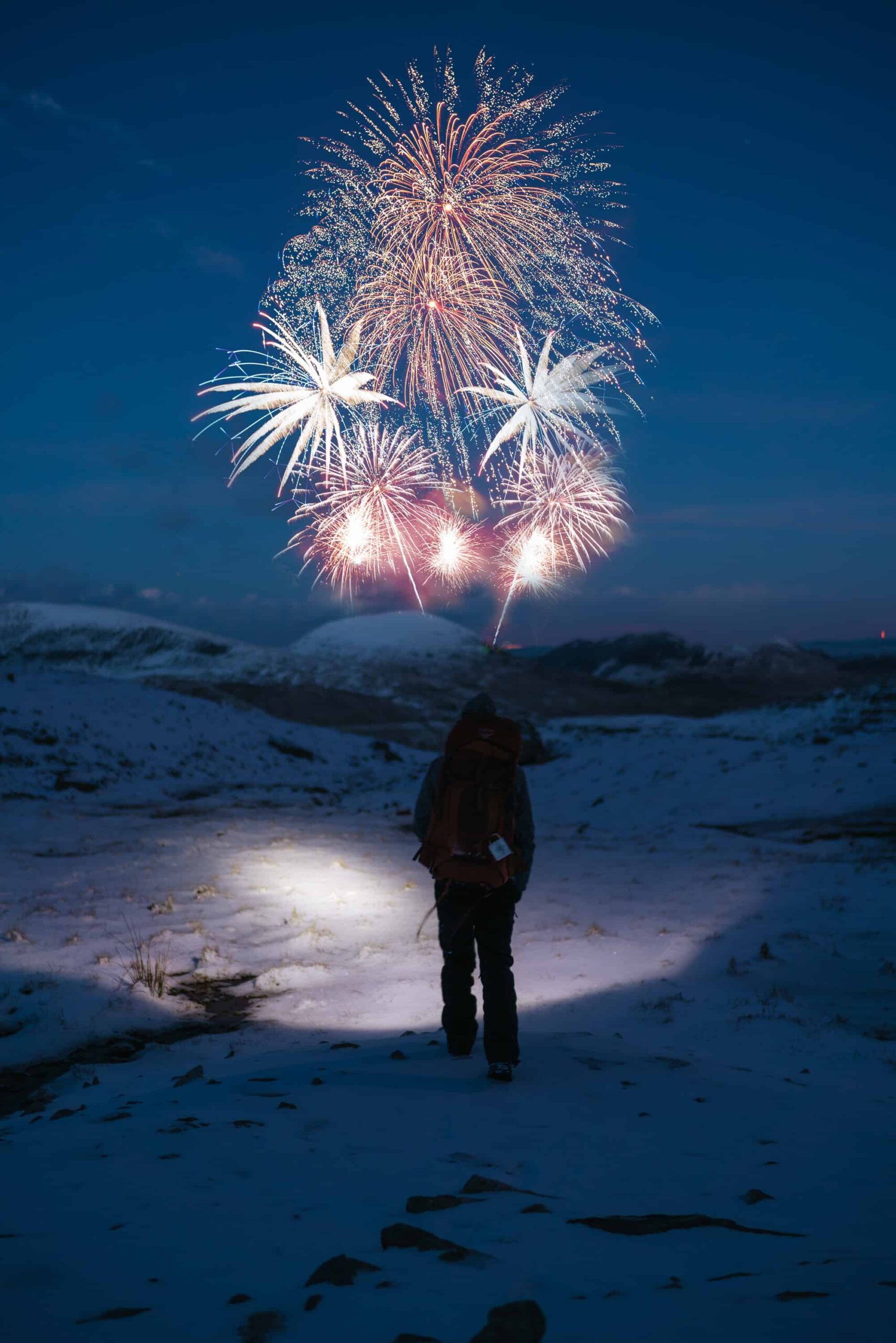
a person standing in the snow watching fireworks

Thankfully the last time we had to contend with fireworks, a prominent member of the community was kind enough to warn dog owners of the upcoming fireworks and thus warned the large horse community as well. I made arrangements to bring the horses in and felt better for it and then went to ride my horse at another barn.

All that planning and then…

Well, wouldn’t you know that those plans fell through entirely due to babies waking up at the wrong time? So my husband ended up peering anxiously through that same window and found two non-hysterical horses in the paddock, watching the light show.

This all goes to show you that despite careful planning, sometimes things go awry. And despite careful planning, sometimes you just don’t need it. So much energy into something that thankfully didn’t happen.

What do they say? Plan for the worst and hope for the best? I guess that was my motto today!

Have you ever planned for something only to have everything go wrong anyway?