Posted on Leave a comment

Hoof Trimming Practicum

Originally published on April 19, 2019

Estimated reading time: 3 minutes

My back hurts, but that’s a good thing! Today I put into practice what I learned from the hoof clinics from Metta Equus. If you missed my reviews of the two first levels, here are Level 1 and Level 2. For my hoof trimming practicum, I chose to trim my husband’s gelding Obélix because he has great feet and is really patient.

Before we trim

My teacher for the day, Maia started by running through what she usually looks at when she trims a horse for the first time. We discussed the list and took the time to thoroughly look him over for any oddities.

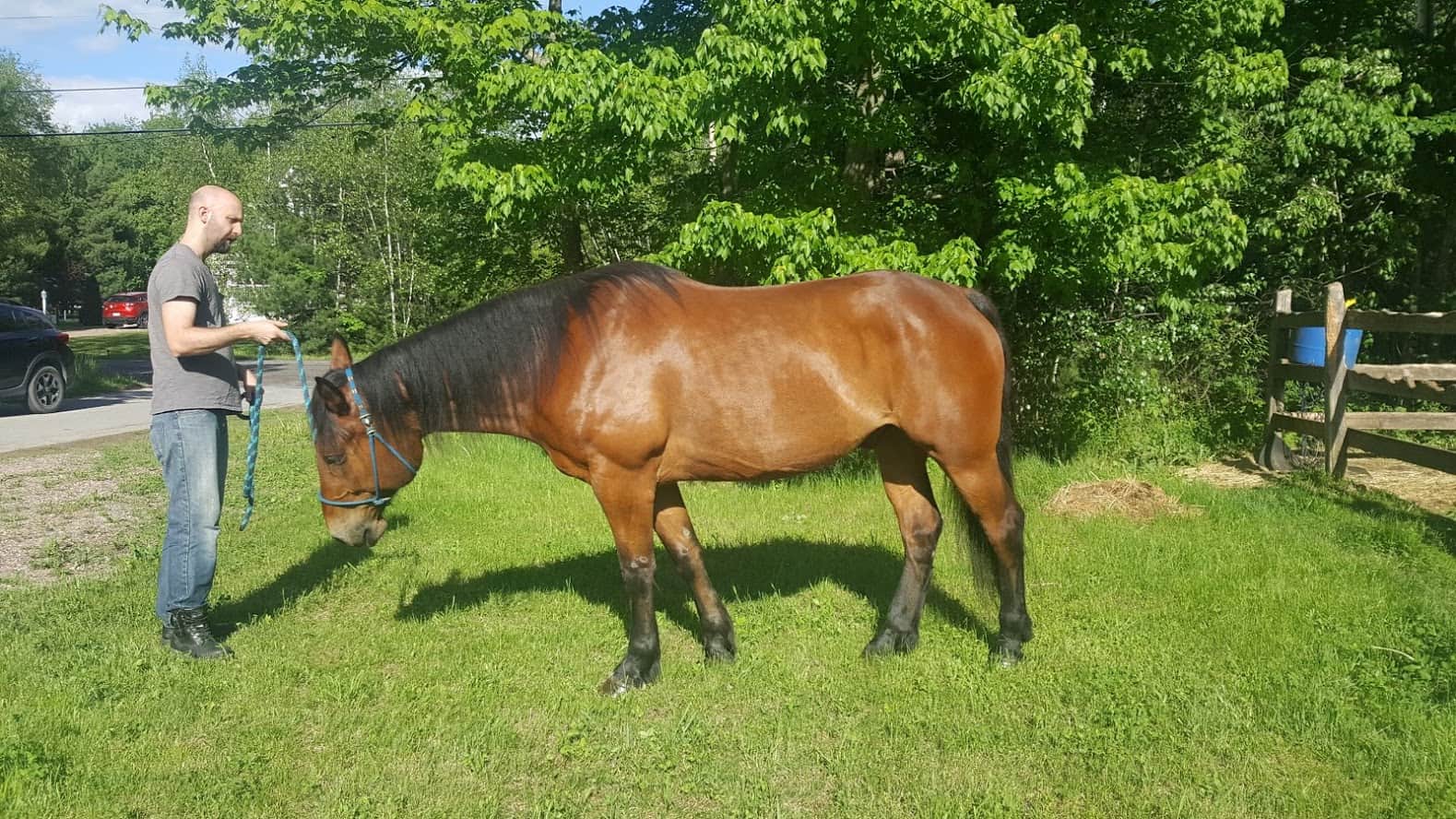
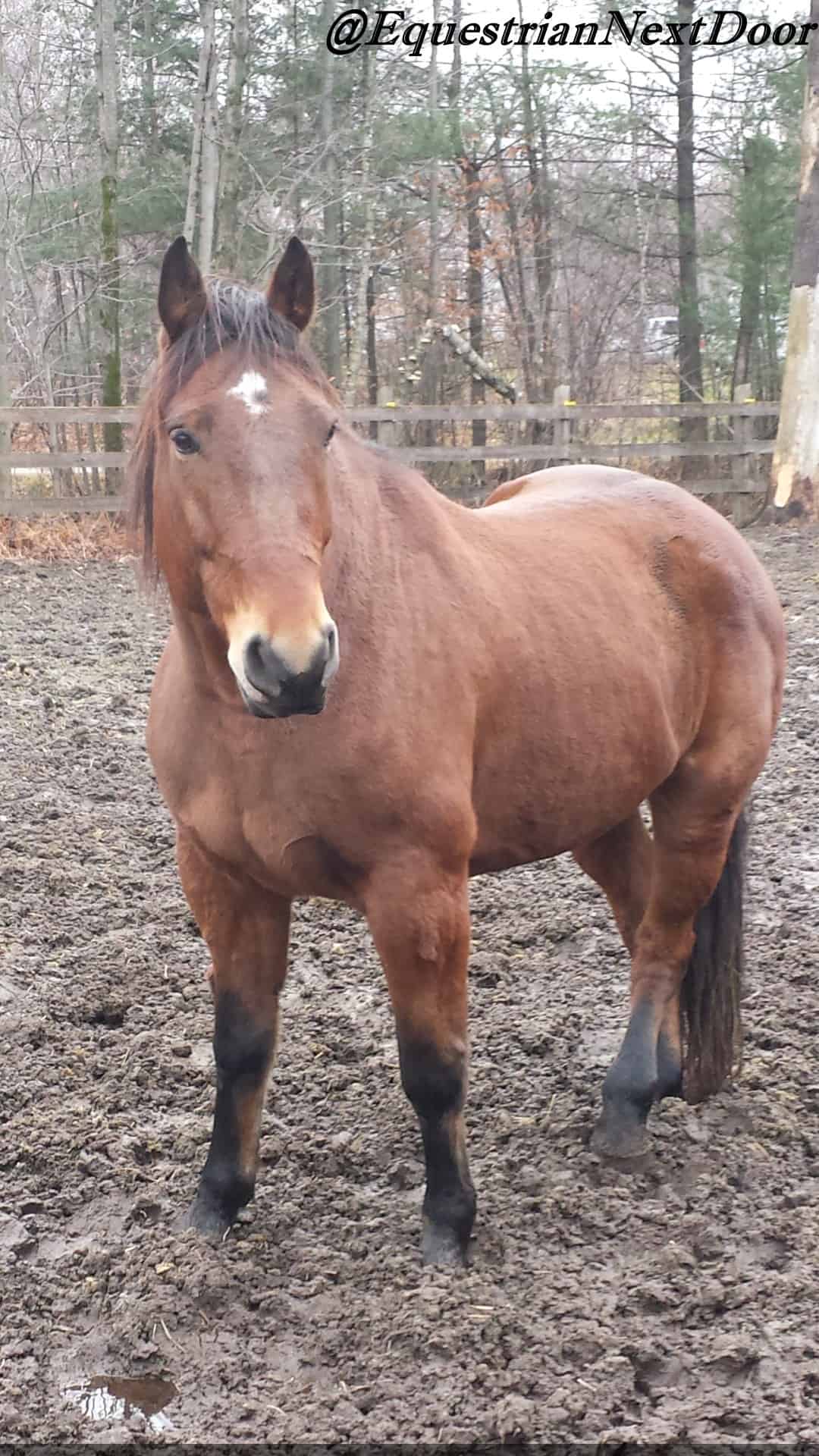
During the exam, we noticed that his chest and shoulder muscles were overdeveloped on the left side (the right side of the images below). He is returning to work slowly, but it is something we would keep in mind while trimming his hooves. Not to mention that, for the moment, this horse cannot pick up the right lead at a canter. We are working on it though, but it was interesting to pick up a few more pieces of that puzzle. He also holds his tail to the right side.

The plan was for me to trim two feet, one fore and one hind, and for Maia to do the same on the other side. I had a great time discussing Obélix’s hooves with such a knowledgeable and patient teacher. Maia suggested I start trimming with a rasp and avoid the nippers so that I was less likely to take off too much. We did a conservative trim and discussed the different parts of the hoof and how he was using his feet. It was interesting to note that despite his apparent crookedness, he is wearing his hooves evenly.

In the end, we felt confident that I could trim Obe’s hooves alone in three weeks and that Maia would take a look when she was in the barn next.

Next Steps

I also have takeaways now that I have taken a closer look at my hubby horse. He had a previous shoulder injury and a bone chip floating around in there, so it isn’t surprising that the opposite shoulder compensated and thus muscled differently! Now I will investigate how to muscle him correctly and gently to help him feel better in his body.

And I’ll be trimming him in a few weeks!

Practicum Review

This practicum and many more trims with Maia’s guidance complete the Hoof Clinic series from Metta Equus. I cannot thank Maia and Catherine enough for their patience and time. They are excellent teachers who are patient and eager to share their knowledge. During this practicum, I was able to put to use the knowledge in Level 1 and Level 2 and gain a true appreciation for their work. If you are interested in attending one of their clinics, check out their website.

Posted on Leave a comment

Review: Equine 74 Gastric

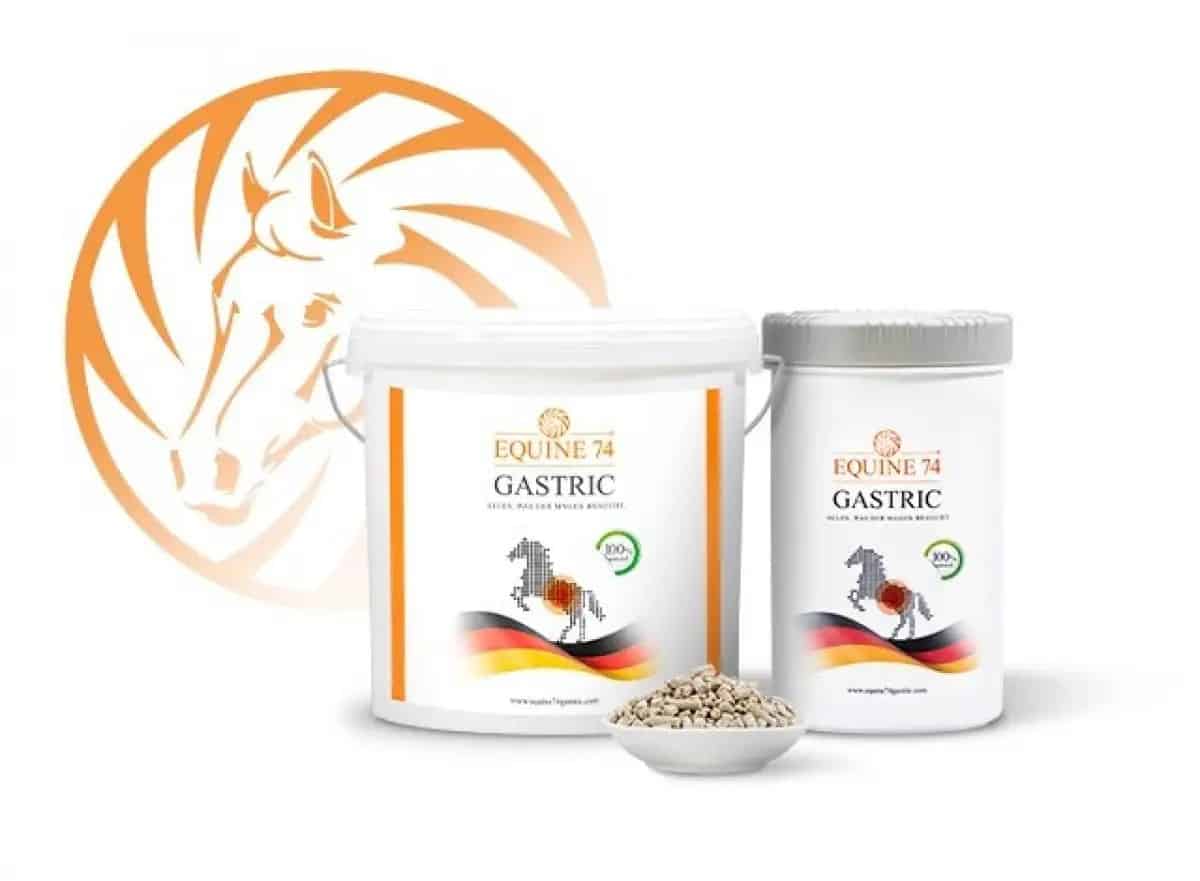
Equine 74 Gastric

I had the chance to try Equine 74 Gastric, a horse ulcer treatment, and wanted to share the details in hopes to help other horse owners with this unfortunately common horse condition. A special thanks to Sarah from Horse Gear Canada for sending me the free sample. Although she sent me the first sample for free and asked for nothing in return, I decided to write a review for Equine 74 Gastric, a product that has changed my horse’s story for the better and have continued to purchase from Sarah since.

Alice’s ulcer story

Alice, my 18-year-old warmblood mare, developed ulcers three years ago when we were training to compete in eventing. Her ulcer story is typical: she was grinding her teeth and lashing out. Brushing and blanketing were unpleasant for both of us. My sweet mare had become a nightmare to ride and groom. At the time, my trainer thought she was sassy and opinionated: I felt there was something deeper at work. 


After an awful jumping lesson, during which my girth needed to be tightened to which my mare objected (and nearly kicked the person who went to tighten the girth), I knew I had to do something about it.


It was time to call the vet. I provided the symptoms above. Then the vet commented that my mare was in a lot of pain. My heart sank. We had two options: scope her for ulcers or treat her with omeprazole and see if it worked. We decided to treat her and change her feed regiment by adding alfalfa cubes and spreading out what grain she did receive. It was a lot of work, and the small barn where I boarded her could not viably accommodate all the changes, so I brought Alice home to care for her. 


The initial treatment

That spring, Alice and I went on easy trail rides and just concentrated on getting her tummy better. By the end of two omeprazole treatments, I started her on a double dose of Madbarn’s Visceral+ under a Madbarn equine nutritionist’s advice. For the next six months, Alice was religiously fed Visceral+, much to her dismay. She didn’t care for the taste. When I felt she had fully recovered a full year after her diagnosis, I weaned her off the Visceral+. 


Unfortunately, she again showed signs of ulcers six months later, and she wasn’t being ridden consistently. Thankfully, I met virtually this wonderful horsewoman named Sarah Chambers, Horse Gear Canada owner, who had a product that could help my horse. She sent me a 6-week sample of Equine 74 Gastric for me to try with Alice. In exchange, I would document Alice’s journey towards ulcer recovery. 

The trial

When I first received the small box, I was surprised at the weight. It was heavy! Once I had opened it, there were a few sprinkles of white powder that had loosened during shipping. The consistency of the powder is like flour, so don’t sneeze! You’ll find some everywhere after! It has a mild vanilla smell as well. (AN: The powdered form has since been discontinued; however, the pellet form is just as effective and easier to work with.)


I prepared Alice’s beet pulp mash that night and sprinkled a partial scoop of Equine 74 Gastric into it. I slowly brought her to the full dose over a few days, just so that she could get used to the taste. Unlike the Visceral, she never had an issue with the taste of Gastric. It’s important to mention that at this point, my mare was a picky eater, typical of ulcery horses. She didn’t eat anything that was out of the usual. For her to eat it without a second thought was a massive win for Gastric. 

Here are the videos I recorded for my Facebook page at the start of the 6-week trial, three weeks in and at the end. You’ll notice a considerable difference in Alice’s reaction at the 3-week mark and a completely different horse at six weeks. 

I continued to use the products for several months as it helped Alice so much. Here is my review of Equine 74 Gastric.

Equine 74 Gastric

Pros of Equine 74 Gastric

  • It actually works and it works quickly! It only took six weeks to see a difference.
  • Palatable and easy to feed, thanks to the vanilla flavour.
  • Easily integrated into a wet mash! It is now only available in pellet form.
  • Natural ingredients.
  • Free of FEI banned substances.

Cons of Equine 74 Gastric

  • More expensive at $3.85/day compared to other non-prescription horse ulcer treatments, but definitely less expensive than several rounds of omeprazole!
  • The powder is very fine, like flour, so it could quickly make a mess.
  • The long narrow bottle combined with the scoop makes it hard to get to the product when you start hitting the bottom.

Overall Impression

My official review of Equine 74 Gastric is that it has my vote as a treatment for ulcers. The natural formula combined with the palatability made this product ideal for Alice. For it to work so quickly was a welcome surprise! Despite the price, this product is now my first recourse when treating or preventing ulcers in horses. 


If you are struggling to help your horse with ulcers, this product can help! Purchase Equine 74 Gastric from Horse Gear Canada today.

Related

Posted on Leave a comment

6 simple steps to clean your horse brushes

Horses are creative when it comes to getting dirty. Any puddle of muck is fair game, including using their own poop as a pillow. Despite this, it’s essential to keep them clean for their health by brushing them and cleaning their brushes regularly. These 6 simple steps to clean horse brushes will help you keep your horse clean and happy and save you time.

Why clean horse brushes

Dirty brushes do nothing more than move the dirt around or, even worse, add dirt. They can also spread diseases such as rain rot and other skin infections. Therefore, it is essential not to share brushes between horses either.

How to clean horse brushes

  1. Shake them out to get the easy-to-dislodge dirt and dust.
  2. Pick out the mane and tail hairs.
  3. Vacuum them.
  4. Wash them with a little bit of horse shampoo.
  5. If it has been a while since they’ve been cleaned, soak them a few minutes in a vinegar solution (use cleaning vinegar here, not the stuff for your salad) to disinfect them.
  6. Rinse clean and towel dry and let air dry, bristles down or on the side.

How often should you clean them?

Clean your horse brushes at least once every second week and more often during muddy season.

Dirty brush kit
Rinsing curry in the sink

Conclusion: Clean your brushes!

In short, it takes just a few minutes to clean your horse brushes and keep your horse’s coat healthy. So grab all your brushes and take a few minutes to clean them.

Brushes drying on a towel

Related

Posted on Leave a comment

Equestrians: Best tracking apps

Whether it is to make our equestrian life easier or to track progress towards a goal, apps are there to help! But there are more and more equestrian applications on the market, so which one is worth downloading? This list of the best exercise tracking apps for equestrians on Android and Apple in 2020 will help you find the right app for you.

Exercise tracking

Equilab

Equilab tracks your trail rides and your training with details like time, elevation, gaits and calculates roughly the caloric expenditure of your horse and you. It uses GPS to map your rides, so it is less likely than cell coverage to lose the signal. Equilab also allows you to share horses like when you are leasing a horse and has a calendar where you track the visits from different equine professionals. It also pairs with your Wear OS by Google.

If you subscribe to the Premium version at $12.99/month or $99.99/year, you can export your training data and use the safety features that alert people should you fall off your horse or need help. 

Available for Apple and Android

Equisense – Horse Riding Improvement

Equisense is your ultimate training companion. It uses the measurements that your phone takes while you ride and gives you a detailed picture. You can choose what you want to work on. You can pair it with the company’s biosensor for your horse. The sensor is expensive, but what you can do with just your phone is impressive and useful. 

Available on Apple and Android. 

Horse Riding Tracker

Horse Riding Tracker is a simple application that tracks your rides. Bonus: It works with your Apple Watch.

Only available on Apple.

HorseGlobe

Horse Globe tracks your rides and offers an impressive list of horse trails. It also allows you to share your rides on Facebook. This app is more about sharing the trace of your rides than documenting your workout.

The basic option is free. The paid version allows you to share more of your rides and trails. 

Available on Apple and Android. 

Prospeqs equestrian

Prospeqs Equestrian supports equestrians in achieving their goals and helps share videos and training data with coaches and friends. 

Available on Apple and Android. 

Ridely – an app for equestrians

Ridely comes with tracking and videos from trainers to help you reach your goals. The structure of this app is really nice and is designed to help you achieve even your long term goals.

Available on Apple and Android. 

There are of course other apps that aren’t designed for horses but have a horseback riding setting for tracking your rides such as MapMyRun

I hope you find this list of the best tracking apps for equestrians useful. I like Equilab and Equisense; however, any of these will track your rides. It all depends on which options you need.

Enjoy the ride!


Related Blog Posts

Posted on Leave a comment

How to waterproof horse blankets

How to waterproof horse blankets

The wet and rainy season is around the corner, and there is nothing worse than lovingly blanketing your horse, only to find a few hours later a cold, wet, shivering horse. You tried to do your best, but something went awry. We’ll go into detail on how to waterproof your horse blankets and avoid that whole unpleasant situation.

The solution is not to buy a new blanket! As a horse mom to three horses and hobby farm owner, I know how expensive replacing blankets can get.

You can re-waterproof your horse’s blanket for a fraction of the cost of buying a new one! And yes, you can waterproof your horse’s old faded and well-loved blanket.

Did you know that waterproofing on textiles only lasts a short while? It means that you need to re-waterproof your horse’s blanket regularly.

How to choose the right waterproofing

The different waterproofing products are classified into two types: sprays and washes. Sprays are easy to use and versatile compared to washes that require using the family laundry machine (your choice to tell your spouse or not!) or large laundry machines.

4 things to look for in a waterproofing product

  • Pet-friendly—for obvious reasons
  • Little to no odour—we all know animals have sensitive noses
  • Water-based—better for the environment and our horses
  • Breathability—your horse’s sweat still needs to evaporate

Avoid silicone sprays as they are not safe for your horse’s paddock mates to ingest (or your blanket destroyer if you have one). Now that you have found your product onto the fun part!

Steps to waterproof your horse blanket: Spray

  1. Clean your blanket thoroughly and let it dry.
  2. Read the instructions on the bottle.
  3. Find a well-ventilated area with little to no wind.
  4. Spray thoroughly and wipe away any droplets with a soft cloth.
  5. Let dry.
  6. Reapply for the best results.

Steps to waterproof your horse blanket: Wash

  1. Clean your blanket thoroughly and let it dry.
  2. Read the instructions on the bottle.
  3. Hand wash or machine wash your horse blanket using the right quantity of product. If you use a washing machine, you can protect it by tying the buckles together and covering them with an old sock.
  4. Wash using the delicate cycle and cold-water settings.
  5. Remove promptly and let dry.

And you are done! Your horse’s blanket is ready for another rainy and snowy season.


Any questions? Drop them below.

Posted on Leave a comment

Equestrian Autumn To-do List

Autumn Equestrian to-do List

You know you need to get your horse stuff ready for fall, but don’t know where to start? Are the fewer hours of sunlight getting to you? Yeah, me too.
This Equestrian Autumn To-do List will help you target and cross those things off your list. Don’t be impressed by the size of it. Some items are quite fast but often overlooked, and others take a bit of time. Remember! One bite at a time – You’ve got this!

Your to-do list

Remember to do one thing at a time and plan longer tasks by putting them in your personal to-do list or calendar. In the end, it will be worth the peace of mind.

Tack

Tack includes your saddle, bridle, boots, polos, wraps and saddle pads. You may have more stuff, but that’s the bulk of it!

  1. Clean and condition tack thoroughly.
  2. Waterproof your tack.
  3. Inspect for cracks and stretching and have any damage repaired. Replace tack as needed.
  4. Check your saddle’s fit or plan to have a saddle fitter come out. 
  5. Go through your saddle pad collection. Wash your saddle pads and recycle the old ones.
  6. Stud your hoof boots, if you use them.

Grooming Kit

For example, your brushes, hoof picks, grooming gloves, sponges, towels, etc.

  1. Disinfect your brushes, especially your hoof pick, and brush box.
  2. Donate or sell any brushes you haven’t used in ages.
  3. Go through your horse products and first aid kit. Throw out the very old or expired ones. 

Horse Blanket

  1. Fix tears and missing buckles.
  2. Donate or sell old blankets that no longer fit.
  3. Wash using a blanket wash and rinse.
  4. Waterproof your horse’s rain and winter blankets.

Clothing

  1. Go through your riding clothes to see if they still fit or need to be replaced. 
  2. Clean and condition your summer riding boots and chaps.
  3. Pull out your winter riding gear
  4. Waterproof your winter gear.
  5. Stock up on heat packs.
  6. Check your helmet’s expiry or manufacture date. They should be replaced every 5 years or after a fall.

Would you rather have a printable version of the Equestrian Autumn To-do List? Here it is!

Hit up our Facebook group for trail riders for regular tips and tricks and exclusive member promotions.

Posted on Leave a comment

How to wash horse blankets

how to wash horse blankets

If your horse loves to roll in the mud, you are no stranger to dirty blankets (or horses). You may have wondered what the best way to wash horse blankets at home inexpensively is. Also, clean horses don’t stay clean under dirty blankets.

As a mom to three horses and hobby farm owner, I know how expensive replacing blankets and regularly washing blankets can get. With the right products and techniques, you can make sure your horse blankets last without creating a hole in your budget. Here are some easy steps you can do at home to wash your horse’s blanket.

Steps to clean your horse blanket

  1. Let the blanket dry! Your washer will thank you.
  2. Use a stiff-bristled brush to remove the dry dirt and grime. If it is filthy, you may want to hang the blanket on a fence and hose it down. Use mild dish soap to get the stubborn muck stains out.
  3. Use a saddle pad and blanket wash detergent designed for animals to protect their skin and the blanket’s waterproofing.
  4. Hand wash your horse blanket in cold water or use the delicate cycle on your washer. If you use the washing machine, you can protect it by tying the buckles together and covering them with an old sock.
  5. Add a rinsing agent (not fabric softener!) to your fabric softener dispenser to deodorize and add anti-static conditioning. 
  6. Remove promptly and let dry.
  7. Waterproof as needed.

That’s it! You now know how to wash your horse blankets and it is ready for another round of rolling in the mud.


Any questions? Drop them below or join our community of fun-loving trail riders on Facebook!

Posted on Leave a comment

3 items to check before blanketing your horse

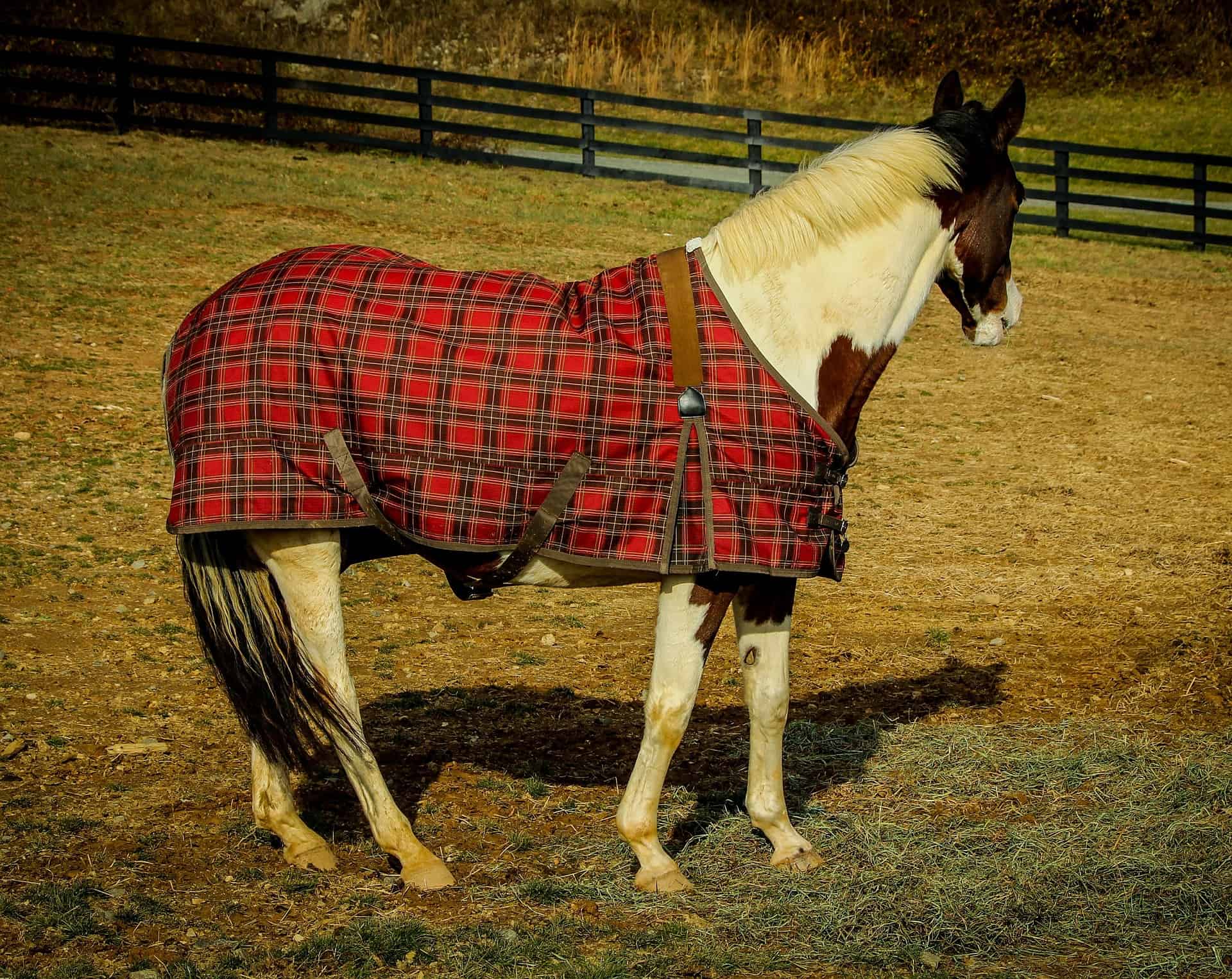
As an equestrian, it is so hard to know when to blanket your horse during the winter. As a hobby farm owner with her horses at home, I found two articles describing what you need to look at as you decide to blanket or not.

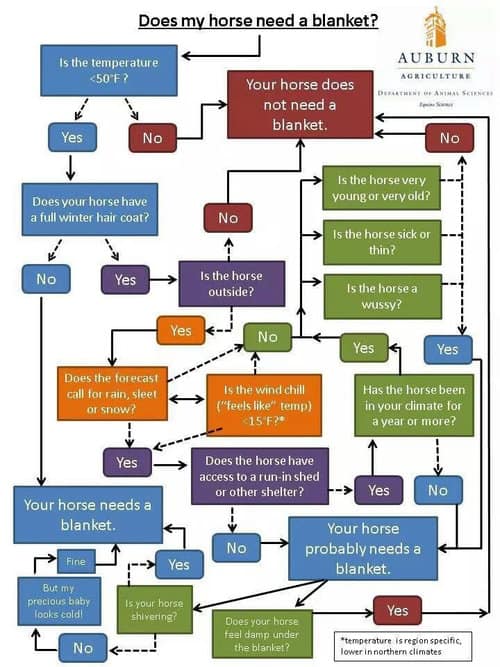
The first article Should I Blanket My Horse In The Winter? by Dr. Lisa Nesson published on IronGate Equine Clinic made recommendations based on hair coat, types of blankets and their fit as well as the basic requirements for roughage, water, and shelter. She talks about the hair coat’s abilities to withstand cold weather without a blanket, which allows the hairs to trap insulating air to keep the horse warm. She even included an infographic to help readers decide when to blanket.

Does my horse need a blanket? Decision chart.
Inforgraphic from Auburn Infographic

The second article published by the Feed Room, When to Blanket a Horse: Ask the Expert, Marcia Hathaway, Ph.D., answers this question by setting out some keep points about shelter and weather conditions, as well as age and body score. She mentions that horses continue to grow their winter coat until December 22 and start to lose it as the days start to get longer near the summer solstice.

Horse Blanketing Checklist

Based on these two articles and my experience as a horse owner, I have listed three things you need to check before deciding to blanket your horse:

  • Examine coat condition – If your horse has a thin coat, put a blanket on.
  • Check age and health – If your horse is very young, very old or has underlying health conditions, put a blanket on.
  • Evaluate body condition – If your horse’s body condition is less than a 3 on 9, put a blanket on.

Now you know what to consider before blanketing your horse.

My name is Chloe. I’m a passionate equestrian, horse lover and hobby farm owner with three horses in my care. I’ve been riding (on and off) since the tender age of 6 and love to discuss anything horse-related. Feel free to connect with me at @eqnextdoor on Twitter or Equestrian Next Door on Facebook.

Posted on Leave a comment

What not to do when selling a horse

As some of you may know, my hubby has decided to rehome his horse as he no longer has time to ride and wants to find a good home for him.

This adventure started in January and has been a rollercoaster since. I won’t go into the details here, that will be for another post, but I felt that sharing what we had figured out so far from our experience and from what we have seen other people do would be important… and help others avoid some mistakes.

What not to do

⊗ Ask your hubby to take pictures of the horse while you are holding it.


Talk about timing…


⊗ Ask your hubby to hold the horse while you are taking pictures.


The finger on the lead… and the horse.


⊗ Forget said pictures when selling – A block of text won’t sell a horse.


⊗ Send your horse out on trial with a friend, without investigating intermittent lameness issues first – This can create lots of issues and put your friendship in danger.


⊗ Lie or make exaggerated claims – Duh!


⊗ Forget to put your post as public on your page – If your Facebook post asks people to share, make sure the privacy settings are set to Public. The pesky “I can’t see what you shared” gets old fast.


⊗ Forget details like vaccination status, farrier, bad habits, or vices etc. – For example, if you are selling a trail horse, it might be important to say he trailers well (and he better do just that!). Or, if your horse cribs, you may want to warn your buyer.


⊗ Have only a verbal contract. Write this stuff out! – This goes without saying…


⊗ Not answer messages regarding your ad or be available for viewings – Nothing is more frustrating for a buyer than an unresponsive or rude seller.


⊗ Stop working your horse as usual – You want to make sure that your horse is in the proper condition to do the job your selling it for. Don’t stop doing your usual stuff for the horse just because you’ve decided to sell it.


⊗ Say how difficult this sale is for you – Potential buyers do not want to buy your drama or get into a situation where you might change your mind about selling it. If you can’t sell the horse without keeping it personal, ask a friend or your trainer to do it for you.


Additional resources

Here are some additional Canadian resources for when you are selling your horse.


Good luck!

Posted on Leave a comment

Equestrians: Horse management apps

With more and more apps designed to help equestrians manage their horse, especially barn owners with many charges, it is hard to choose the right one. Here is a list of the top horse management apps for 2020 on Android and Apple. You are sure to find an app for you.

If you are looking for a list of exercise tracking apps for equestrians, here’s the list!


the EquestrianApp

Equestrian App

The Equestrian App is designed for horse owners and horse business operators, including barn owners, bodyworkers, farriers, and equine dentists. For barns, it includes barn chat to allow boarders and horse owners to discuss and chat. For horse owners, it keeps track of your horse’s appointments so you can stop asking yourself “When was the last time the farrier was out?” 

I was able to test this application extensively thanks Patrick from the Equestrian App, who gave me temporary access to all the Gold features. It was a good experience; however, I never really understood how to share a horse and I wasn’t able to find a FAQ at the time. Their customer support has since improved and my understanding is that the app is getting better and has more options with every iteration. I encourage you to try this app out if you want an all around companion in your phone for all your barn and horse needs.


Available for Apple and Android. Accessible online from a computer.

The basic options are free.

If you want to add Barn Chat, Photo gallery, printing and To-Do’s, it is $2.95/month or $24.95/year for the Silver membership.

$4.95/month or $49.95/year for the Gold membership, you get unlimited horses, file upload, ride tracking, Show and award tracking and business profile enhancements. 


Equitracker

EquiTracker helps you track all aspects of horse care including farrier, deworming and vaccinations. It does have ads though. If you want to remove them, it is a one-time fee of $2.99. 

Available for Android only. 


Horse Health Tracker

Horse Health Tracker was designed by Guelph University. It tracks the important metrics of your horse, such as body condition and body weight calculator. It also has a 5-minute health check assessment. 

The upgrade costs $4.59 to unlock reminders, graphs and videos for two horses. $6.99 for 10 horses and $9.99 for up to 50 horses.

Available on Apple and Android.


Equine organiser

Equine organiser allows you to track all aspects of your horse management on any device, including your computer. It even allows barn owners to organise their staff and service providers with to-do lists and you can also list your horses for sale. 

Available on Apple and Android.


The PonyApp

The Pony App allows you to organize and invoice your different services. It tracks the different horses you ride and keep everything in the same place. The premium version is $9.99/month or $99.99/year. 

Available only on Apple. 


HorseCare – Calendar, Diary

HorseCare is an app that allows you to keep track of all the appointments but also document your horse journey using a journal. It also has a built-in community to share your pictures and updates. The Premium version at $8.99/month or $32.99/year has a few extra features, notably a safety feature, a nutrition calculator and the ability to use it offline. 

Available only on Apple. 


Hooves

Hooves is a journaling app that allows you to share your horse’s information with other riders. You can manually track your training sessions as well. This one is great for those who want to keep things simple.

Available on Apple and Android. 

Conclusion

I hope you find an app that meets your needs in this list. If you have any questions, message me! If you are using another app to track your horse’s appointments and stuff, add it below. I would love to hear about it.

Related